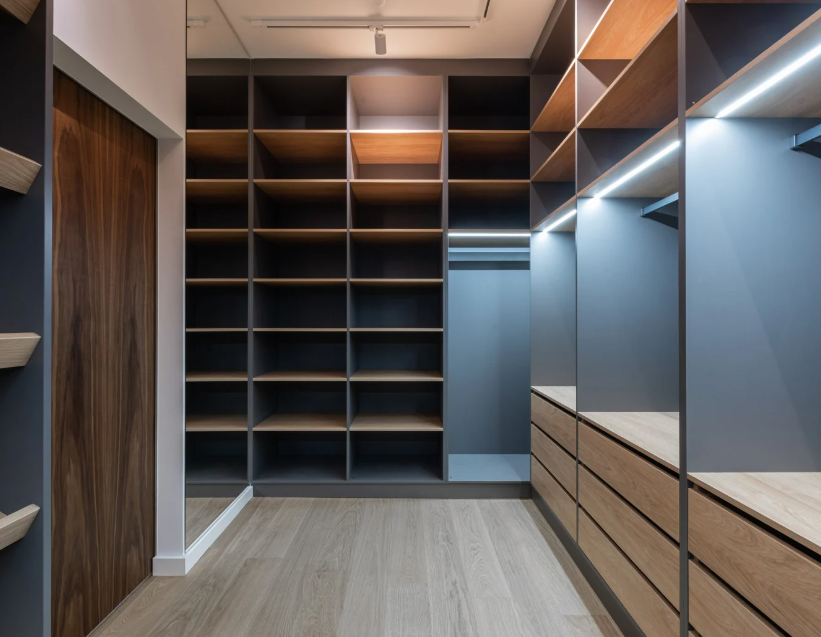
Rechargeable lighting for fitted wardrobes can last for months between charges when used briefly each day, but there is no universal charging interval. Some manufacturers advertise six to eight months based on only two to three minutes of daily use, so don’t mistake those figures for continuous runtime.
Key Takeaways
- Check the usage assumptions behind any advertised battery-life claim.
- Longer operating periods and frequent sensor activations mean more frequent charging.
- Compare brightness settings, sensor controls, and charging arrangements—not battery capacity alone.
- Position lights where clothing will not obstruct illumination or sensor operation.
- Make sure removable lights remain easy to reach for charging.
- Consider wired lighting for wardrobes needing prolonged, everyday illumination.
What Does “Lasts Six Months” Actually Mean?
It usually describes a specific usage pattern, not six months of uninterrupted light.
For example, a manufacturer may base its claim on two minutes of operation per day. A shared wardrobe opened repeatedly throughout the morning and evening could accumulate considerably more operating time.
Before buying, ask:
- How many minutes of daily use support the claim?
- Which brightness setting was used?
- Does the figure assume sensor mode?
- Is the stated duration an estimate or a tested maximum?
- What charging time should you expect?
Compare products using equivalent conditions. A longer advertised interval is not necessarily better if it assumes much less use.
Which Settings Affect Battery Life?
The main practical factors are how brightly the light operates and how long it remains on.
Adjustable brightness can help balance visibility with charging frequency. However, don’t dim the light so much that distinguishing clothing becomes difficult.
Sensor timeout matters too. A light that stays on for 30 seconds after the last movement uses more operating time per activation than one that switches off sooner, assuming otherwise comparable conditions.
Check whether movement restarts the timer and whether an accidental continuous-on setting could explain unexpectedly frequent charging.
Do Motion Sensors Always Save Charge?
They can reduce unnecessary operation, but their effectiveness depends on the controls and placement.
Some lights activate whenever they detect movement. Others include a darkness-sensitive mode that prevents activation when sufficient ambient light is available.
Inside an enclosed wardrobe, the sensor may detect darkness even during the day. Do not assume this mode will always eliminate daytime use.
Test the light with doors open and closed. Clothes, shelf edges, and dividers should not obstruct the sensor or the area being illuminated.
Does Winter Mean More Frequent Charging?
Possibly, if your usage changes.
During November and December, darker mornings and evenings may increase reliance on wardrobe lighting. Selecting outfits for holiday events or accessing seasonal storage can also add operating time.
The shorter charging interval would result from increased use—not simply the calendar.
Track the first few weeks of operation to establish a realistic schedule for your household rather than relying entirely on the packaging.
How Can Fitted Wardrobe Design Make Charging Easier?
Plan charging access before fixing lights into place.
Magnetically mounted or otherwise removable fittings can simplify charging, but confirm exactly which part detaches. Some designs use a removable battery; others require removing the complete light.
Check that:
- Shelves and hanging rails do not block removal.
- The charging port remains accessible.
- The supplied cable and recommended power source are suitable.
- Repeated removal will not disturb the mounting.
- Replacement parts or batteries are available, where applicable.
Follow the manufacturer’s charging instructions rather than assuming every USB-powered light accepts the same arrangement.
When Is Wired Lighting More Practical?
Consider wired lighting when the wardrobe is used for extended periods, contains several illuminated sections, or would make repeated charging inconvenient.
A rechargeable fitting can suit an existing wardrobe without a nearby power connection. A new fitted installation provides an opportunity to compare that convenience with a properly designed wired system.
Superior Closets designs and installs custom closet organizers and built-in storage. Discuss lighting positions, sensor sightlines, and charging access alongside the shelving and hanging layout. Ask which lighting arrangements can be accommodated so the finished wardrobe remains practical to illuminate and maintain throughout the year.